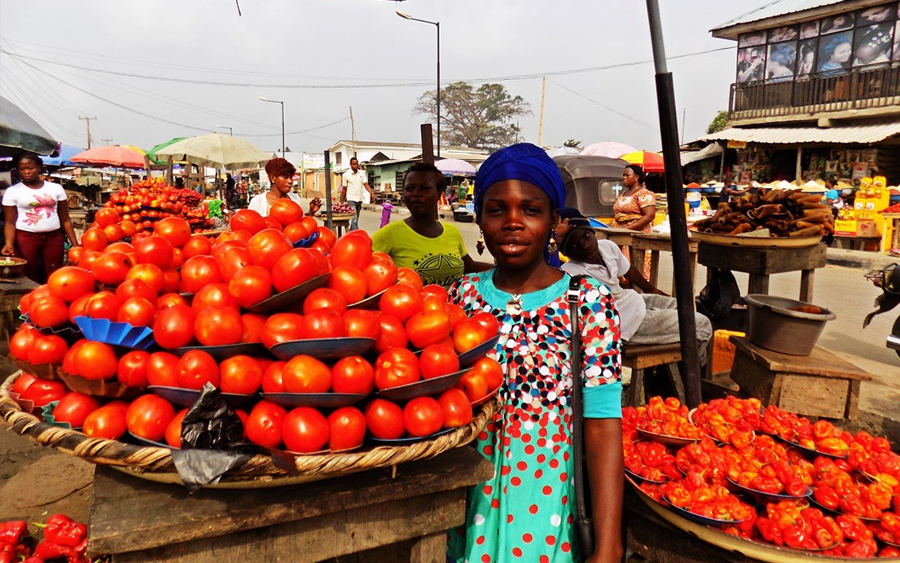
Tomato traders and importers in Accra have warned of a looming shortage and possible spike in tomato prices following recent terrorist attacks in Burkina Faso that have disrupted cross-border supply.
They are urging government to invest in local irrigation infrastructure to boost domestic production and reduce Ghana’s reliance on imports from Burkina Faso, a key source of tomatoes for the Ghanaian market.
The warning follows attacks in Burkina Faso that reportedly killed eight Ghanaians and injured several others, raising fresh concerns about the safety of traders and drivers who travel the route.
Esther Owusu Ansah, a tomato importer with more than 30 years’ experience, told Citi Business News that traders may halt trips to Burkina Faso if adequate security is not guaranteed.
“If the government and security agencies do not provide us with adequate protection, we will not bother travelling to Burkina Faso anymore. Our drivers have families, and they cannot risk their lives just to transport tomatoes,” she said.
She noted that while security escorts are sometimes arranged up to Paga, the stretch beyond remains unpredictable.
“Our Chairman usually arranges security escort up to Paga, but beyond that point, we do not know what may happen. Because of these risks, we are even beginning to reconsider importing tomatoes altogether,” she added.
Another trader, Adwoa Pinnaman, called for urgent investment in irrigation systems and dam construction to support local tomato farming.
“We thought we were not targets of the terrorists. We want the government to construct dams for us that will prevent us from going to Burkina Faso,” she said.
She further alleged that traders spend significant amounts importing tomatoes from Burkina Faso, only to receive produce that is often of poor quality.
“Many of the tomatoes we get are usually rotten,” she added.
Otumfuo Charity, Queenmother of the CMB Underbridge branch in Accra and an executive member of the Ghana National Tomato Traders Association, warned that some traders from Togo may attempt to exploit the disruption.
“Some of these traders use routes through northern Togo under the pretext of selling to their counterparts, but they end up selling the tomatoes directly to Ghanaian traders,” she explained.
She stressed that the association would resist any illegal import practices.
“We want to make it clear that we will not accept this, and we will issue a warning against such practices,” she said.
Drivers and transporters say the disruption has already affected their livelihoods.
Kwame Siaw, a driver at the CMB Underbridge branch, said many workers may be forced to seek alternative income sources if supplies remain low.
“Now, we may be compelled to find other alternative sources of livelihood… but that kind of work is not sustainable,” he said.
Another driver, Peter Boahen, who has been in the trade since 2006, warned that the impact would be felt widely.
“With fewer tomatoes on the market, prices will become more expensive. Since the main trucks that transport tomatoes from Burkina Faso are no longer coming, we will be left sitting here idle. How then will we take care of our families?” he asked.